WhatsApp Business API pricing is simpler than it looks once you know the three things that set the price of a message: what kind of message it is, which country the customer's number is from, and whether the customer wrote to you first. This guide gives you Meta's current rates for the countries most of our customers sell to, explains the change Meta made on 1 October 2026 that put a price on many replies, and works through what a real month costs.
So you know where we stand: we make ZingaConnect, a CRM with a WhatsApp inbox, and the businesses in our own group send thousands of WhatsApp messages a week through it, most of them to customers in India. Some of what follows we learned from our own bills.
The short version
- Meta charges per delivered message, not per conversation. A message that fails or is held back costs nothing.
- The price depends on the category (marketing, utility, authentication or service) and the customer's country, worked out from the country code of their number.
- Marketing is by far the most expensive: $0.025 a message to the US and Canada, $0.0635 to the UK, $0.1365 to Germany and $0.0118 to India.
- Since 1 October 2026, replies are no longer free. Each business number gets 1,000 free service messages a month; after that, replies inside the 24-hour window are charged, and so are utility templates sent inside it.
- Whoever provides your WhatsApp software may add a monthly fee, a markup on each message, or both. That's where most of the difference between quotes comes from.
What Meta charges for
Every message your business sends falls into one of four categories, and the category sets the price:
- Marketing templates: offers, launches, back-in-stock alerts, abandoned-cart nudges and anything else that sells. These are the messages you can send to opted-in customers who haven't written to you recently.
- Utility templates: order confirmations, shipping updates, appointment reminders, account alerts. They have to be about something the customer has already done or asked for. Put a discount in one and Meta will reclassify it as marketing.
- Authentication templates: one-time passcodes. In some countries, a business based elsewhere pays a higher authentication-international rate; India is one of them.
- Service messages: ordinary free-form replies, sent while the customer service window is open. The window opens for 24 hours each time a customer messages or calls you.
Messages customers send to you are free. Meta charges only when one of your messages is delivered, in the currency your WhatsApp Business account was set up to pay in, at the rate for the country code of the number it went to. So a UK business messaging a customer with a German number pays the German rate.

Inside the 24-hour window, a customer is already talking to you. Outside it, every message is a paid template.
WhatsApp Business API rates by country
These are Meta's list rates per delivered message from 1 October 2026, in US dollars. In every country below, utility, authentication and service messages cost the same; marketing costs roughly two to nine times as much.
Meta's rate card, 1 October 2026
Cost per delivered message, in US dollars
| Marketing | Utility and authentication | Service (after 1,000 free) | |
|---|---|---|---|
| North America and Europe | |||
| United States and Canada | $0.025 | $0.0034 | $0.0034 |
| United Kingdom | $0.0635 | $0.022 | $0.022 |
| Germany | $0.1365 | $0.055 | $0.055 |
| France | $0.0859 | $0.03 | $0.03 |
| Netherlands | $0.1597 | $0.05 | $0.05 |
| Italy | $0.0795 | $0.03 | $0.03 |
| Spain | $0.0707 | $0.02 | $0.02 |
| Ireland and the rest of Western Europe Austria, Belgium, Denmark, Finland, Ireland and others | $0.0592 | $0.0171 | $0.0171 |
| Asia Pacific, Middle East and Latin America | |||
| Australia Billed at Meta's Rest of Asia Pacific rate | $0.0842 | $0.0113 | $0.0113 |
| India Authentication-international: $0.0304 | $0.0118 | $0.0014 | $0.0014 |
| Singapore | $0.0732 | $0.016 | $0.016 |
| United Arab Emirates Authentication-international: $0.051 | $0.0576 | $0.0157 | $0.0157 |
| Saudi Arabia Authentication-international: $0.0598 | $0.0576 | $0.0107 | $0.0107 |
| Brazil | $0.0625 | $0.0068 | $0.0068 |
| Mexico | $0.0397 | $0.0085 | $0.0085 |
From Meta's WhatsApp Business Platform rate card, effective 1 October 2026. Rates are set by the customer's country code. Meta can change them on 1 January, 1 April, 1 July and 1 October.
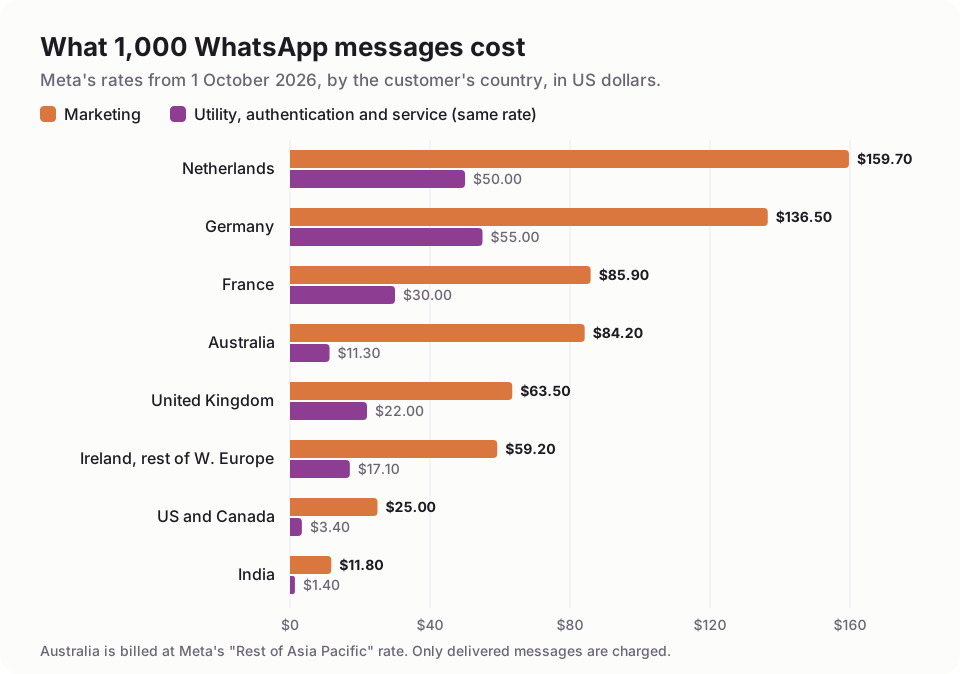
Marketing costs several times more than an order update in every market.
Per message the numbers look tiny, so it helps to think in thousands. A thousand marketing messages to UK numbers cost $63.50; the same thousand to US numbers cost $25, and to Indian numbers $11.80. A thousand order updates to the UK cost $22.
The gap between countries is wider than most people expect. Marketing to German numbers costs more than five times as much as marketing to American ones, and Australia, which Meta bills at its "Rest of Asia Pacific" rate, costs more per marketing message than the UK.
In your billing currency
Your WhatsApp Business account pays in one currency, chosen when it was set up, and Meta publishes a full rate card in each of the 16 currencies it bills in. If your business and your customers are in the same country, these are the numbers on your invoice:
Messaging customers in your own country
| Marketing | Utility, authentication and service | |
|---|---|---|
| United States, billed in USD | $0.025 | $0.0034 |
| United Kingdom, billed in GBP | £0.0458 | £0.0159 |
| Germany, billed in EUR | €0.1131 | €0.0456 |
| France, billed in EUR | €0.0712 | €0.0248 |
| Australia, billed in AUD | A$0.1095 | A$0.0148 |
| India, billed in INR | ₹0.8631 | ₹0.115 |
Meta's list rates in each currency, effective 1 October 2026. Taxes such as VAT or GST may be added to Meta's invoice.
If your business is in India, Meta started billing in rupees on 1 January 2026, and its documentation asks Indian businesses still paying in another currency to move their accounts across by 31 December 2026. Your provider or WhatsApp Manager will show which currency your account uses.
What changed on 1 October 2026
For a little over a year, the cheapest part of WhatsApp was free. Meta stopped charging for customer service replies in November 2024, and for utility templates sent inside an open service window in July 2025. From 1 October 2026, both are charged again:
- Each business phone number gets 1,000 free service messages a month. The count resets at midnight on the first of the month, in your WhatsApp account's time zone, and unused messages don't roll over.
- From the 1,001st reply in a month, each service message is charged at the country's service rate, which today is the same as its utility rate.
- Utility templates sent inside the 24-hour window are charged as well, at the utility rate.
- Eligible government and non-profit organisations keep free service messages beyond the monthly allowance.
For a small business that answers a few dozen chats a day, the free 1,000 will cover most months. A busy support team can go through it in a week, and from then on every reply has a price. It's small per message (a third of a cent to US numbers, 2.2 cents to UK numbers), but it now scales with how much your team talks, so it belongs in your budget.
What a real month costs
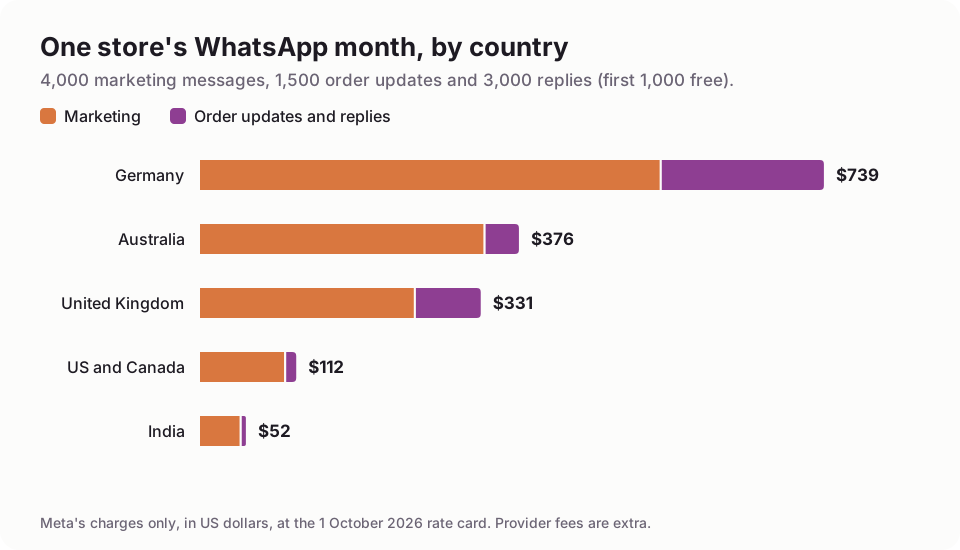
Meta's charges only. Your provider's fees come on top.
Here's a month for a small online store with one WhatsApp number: one promotional broadcast to 4,000 opted-in customers, 1,500 order and shipping updates, and 3,000 replies to customers' questions, of which the first 1,000 are free.
In local money, the same month costs about £239 to UK numbers, €612 to German numbers, A$490 to Australian numbers, $112 to US numbers and ₹3,855 to Indian numbers.
Two things stand out. First, the broadcast is most of the bill everywhere: 77% of it in the UK, 89% in the US and 91% in India. If you want to spend less on WhatsApp, decide what you broadcast and to whom; trimming order updates barely moves the total. Second, the country of your customers matters more than your volume. A shop selling into Germany pays more for 4,000 promotions than a shop selling into the US pays for 20,000.

Broadcasts fill the jar. Order updates barely register.
Six ways to pay less
- Keep utility templates strictly about the order. "Your order has shipped" with a tracking link is utility. Add "and here's 10% off your next order" and Meta reclassifies the template as marketing, which costs about three times as much to UK numbers and seven times as much to US numbers, on every message you send with it.
- Send to people who'll open it. Meta limits how many marketing messages each person receives from all businesses combined, and it holds back the ones over that limit with error 131049. On our own broadcasts it has held back about 30% of a list, and across our group's numbers it held back around 11,300 messages between July and October 2026. You aren't charged for those, because they're never delivered, but you don't reach those customers either. Smaller, better-targeted lists get more through.
- Use click-to-WhatsApp ads for new customers. When someone messages you from one of these ads on Facebook or Instagram and you reply, Meta opens a free entry point window, which its documentation says can stay open for up to 7 days. Every message you send in it is free.
- Answer inside the window. A reply within 24 hours of the customer's last message is a service message: free for the first 1,000 a month, then charged at the utility rate. Let the window close and you need a template, possibly a marketing one.
- Start big broadcasts early. Meta paces each number. We measured roughly 50 marketing messages a minute per number on an 8,638-person broadcast, about 3,000 an hour, however fast our side sent them. A same-day offer to 10,000 people needs most of an afternoon, and messages that land late at night draw blocks and complaints, which hurt your number's quality rating.
- Know when volume discounts apply. Utility and authentication messages get cheaper in tiers, from 5% to 25% off, once a business sends upwards of roughly 100,000 of them a month to a single country. Marketing has no volume discount at any size.
What providers add on top of Meta's rates
Meta's charges are the floor. Most businesses use WhatsApp through a provider (a Business Solution Provider, a CRM or a help desk) and pay for that too. Providers price in four common ways, often combined:
- A monthly subscription, by number of users, contacts or features.
- A markup on each message, either a fixed amount or a percentage above Meta's rate.
- A prepaid wallet that Meta's charges and the markup are taken from, sometimes with a minimum top-up.
- Set-up or number fees, especially for help with business verification.
Before you compare quotes, ask every provider the same questions:
- Does Meta bill me directly, or do you bill me for Meta's charges? If you bill me, at Meta's rate or with a markup?
- Whose WhatsApp Business account is my number registered to? If I leave, does the number, with its quality rating and approved templates, come with me?
- Are there per-user, per-conversation or per-campaign fees besides the subscription?
- What does a month like mine cost in total? Give them your expected marketing, utility and reply volumes, by country.
How it works on ZingaConnect
ZingaConnect connects straight to Meta's Cloud API using your own WhatsApp Business account. Meta bills its message charges to you, at Meta's rates, and we add nothing to them. The number, its quality rating and its approved templates stay in your account whatever you decide about us.
ZingaConnect itself is priced by plan. WhatsApp is included from the Starter plan, $19 a month in the US, with local prices for the UK, Europe, Australia and India on the pricing page. What you get for it:
- A shared team inbox for WhatsApp, email and SMS on one customer record, with assignment, typing indicators and voice notes.
- Templates written in ZingaConnect and submitted to Meta for approval, kept in sync with the category Meta approved them under, so you can see when a utility template has been reclassified as marketing.
- Broadcasts and drip campaigns that respect your quiet hours and turn a "STOP" reply into an opt-out straight away.
- An optional setting that retries messages Meta held back with error 131049, a day later and then at longer intervals.
- Delivery, read and reply tracking on every message, so you can see what a campaign actually reached.
If you're new to the API itself, start with our guide to how the WhatsApp Business API works, and for choosing software around it, what a WhatsApp CRM is.
FAQ
Common questions
How much does the WhatsApp Business API cost per message?
Are WhatsApp Business API replies free?
Is there a free tier for the WhatsApp Business API?
Which country's rate do I pay?
Do I pay for WhatsApp messages that aren't delivered?
How often does WhatsApp change its prices?
Does ZingaConnect add a markup to WhatsApp messages?
Bring your own WhatsApp number
Connect your WhatsApp Business account to ZingaConnect and pay Meta's rates with nothing added.