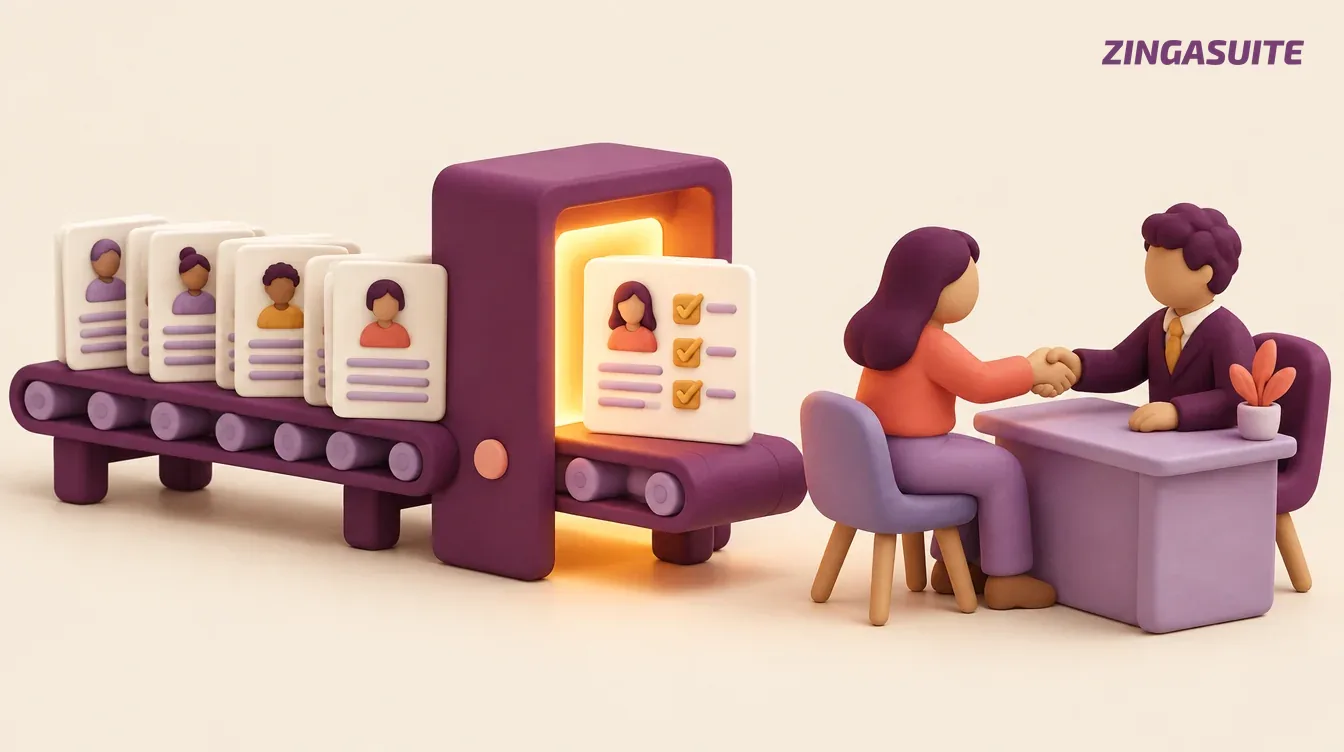
Pre-employment testing means asking applicants to show they can do parts of the job before you hire them: a skills assessment test, an aptitude test, a short work sample. Done well, it saves interview time, spots good people whose CVs undersell them, and makes hiring fairer, because everyone answers the same questions. Done badly, it's a forty-minute hurdle that your best applicants quietly skip.
We see both sides. We build an assessment platform, Zingalify, and we wrote its library of ready-made hiring tests, sixty of them, from sales roles by segment to finance, engineering, support and HR. One is for service technicians on car-wash, steam and wheel-wash systems, the equipment the KKE group behind ZingaSuite makes.

The test should fit the job the way a key fits a lock.
What to test
Test the few things that actually predict success in the role, and nothing else. For a sales role, that might be product judgement and how someone handles a pricing objection. For a support role, troubleshooting and clear written answers. For a technician, the procedures they'll follow on site. A general aptitude test can help where the job is new to the candidate and they'll need to learn fast.
The test that matches the job is also the test that holds up legally, because employment law in most countries asks whether a selection method is job-related.
Writing the test, or choosing one
The best source of questions is the job itself. Ask your strongest people what they actually do in a normal week, and turn the hardest parts into scenarios: the customer who wants a discount, the machine that won't start, the spreadsheet that doesn't reconcile. Then try the draft on two or three current staff before any applicant sees it. If people who are good at the job don't pass, the test is wrong, not them, and their scores give you a realistic pass mark.
If you'd rather not start from nothing, a ready-made role test gets you most of the way; add three or four questions specific to your product or customers.
When to test
Earlier than most teams do. A short skills test straight after application means your interviews go to people who can already do the work, and the interview can be spent discussing their answers instead of reciting a CV. Keep the longest exercise, a paid work sample if you use one, for the final two or three.
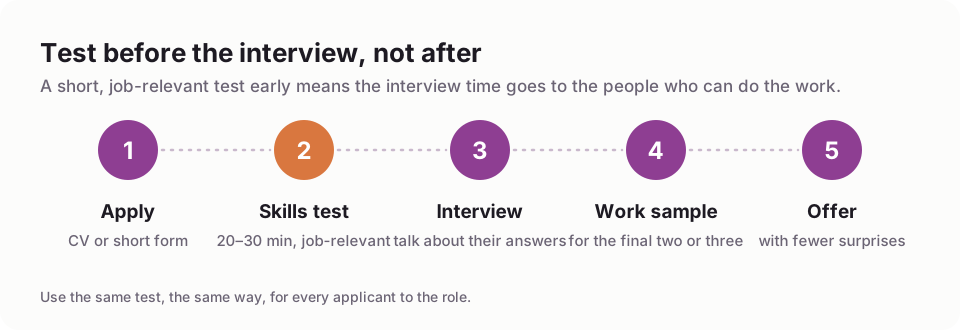
Test early, interview the people who can do the work.
How long, and how hard
Twenty to thirty minutes is enough for most skills screens. Tell candidates the length before they start, let them take it on a phone, and make sure the test saves their answers if the connection drops. Every extra ten minutes costs you applicants, and the ones who leave first are often those with other offers.
Keep it as hard as the job and no harder. A test that only a handful of people pass tells you less than one that spreads people out.

Most applicants will open your test on a phone. Make sure it works there.
Scoring and the decision
Set the pass mark before anyone sits the test, based on what someone who'd succeed in the role should score, and apply it the same way to every applicant. Use score bands rather than ranking people by a single point. A test result should narrow the shortlist and give the interview something to talk about; it should not be the only reason someone is rejected.
After the first fifteen or twenty candidates, look at how each question performed. Questions everyone gets right or wrong, or that strong candidates miss, should be rewritten.
What to tell candidates
A short, honest invitation gets more people to finish. Say why you test, how long it takes, whether it works on a phone, and when they'll hear back. Something like:
Thanks for applying. The next step is a 25-minute skills test about the kind of work you'd do here. It works on a phone or laptop, you can take it any time in the next three days, and your answers save as you go. Everyone who applies for this role takes the same test, and we'll get back to you within a week either way.
Then keep the promise about getting back to them. Candidates who invest half an hour and hear nothing remember it.
Keeping it fair, region by region
- United States: Title VII and the Uniform Guidelines expect selection tests to be job-related and to avoid disproportionately screening out protected groups (the four-fifths rule of thumb). The ADA requires reasonable accommodations, such as extra time or screen-reader support. In New York City, Local Law 144 requires a bias audit for automated tools that substantially assist hiring decisions.
- Canada: provincial human-rights codes require accommodation up to undue hardship.
- United Kingdom: the Equality Act 2010 requires reasonable adjustments, and the UK GDPR limits decisions made solely by automated means.
- European Union: GDPR covers every result, and the EU AI Act treats AI used to evaluate candidates as high-risk, with obligations phasing in. Keep a person making the decision.
- India: the DPDP Act requires clear notice and consent for collecting applicants' data and limits how long you keep it.
- Australia: anti-discrimination laws apply to selection, and the Privacy Act covers how you collect and store candidate data.
Everywhere: use the same test for everyone applying to a role, offer adjustments when asked, tell candidates what you'll collect and how long you'll keep it, and make sure a person reviews borderline results.
Proctoring for hiring tests
For an early skills screen, question pools, random order and a time limit usually do enough. Save webcam proctoring for tests that decide the hire on their own, and tell candidates in advance. Our proctoring guide covers the trade-offs.
Running it with Zingalify
Zingalify lets you start from a ready-made role test or build your own, send each applicant a personal link to a dedicated take portal that works on phones and survives dropped connections, and review results as bands with a breakdown by section. There's no monthly fee: building tests is free and each completed test costs $1 to $3 depending on proctoring. For choosing a platform more broadly, see choosing an online assessment platform.
FAQ
Common questions
What is pre-employment testing?
Are pre-employment tests legal?
How long should a pre-employment test be?
What is a skills assessment test?
Should I use ready-made or custom tests?
Send your first skills test
Start from a ready-made role test or build your own. Free to build, from $1 per completed test.